

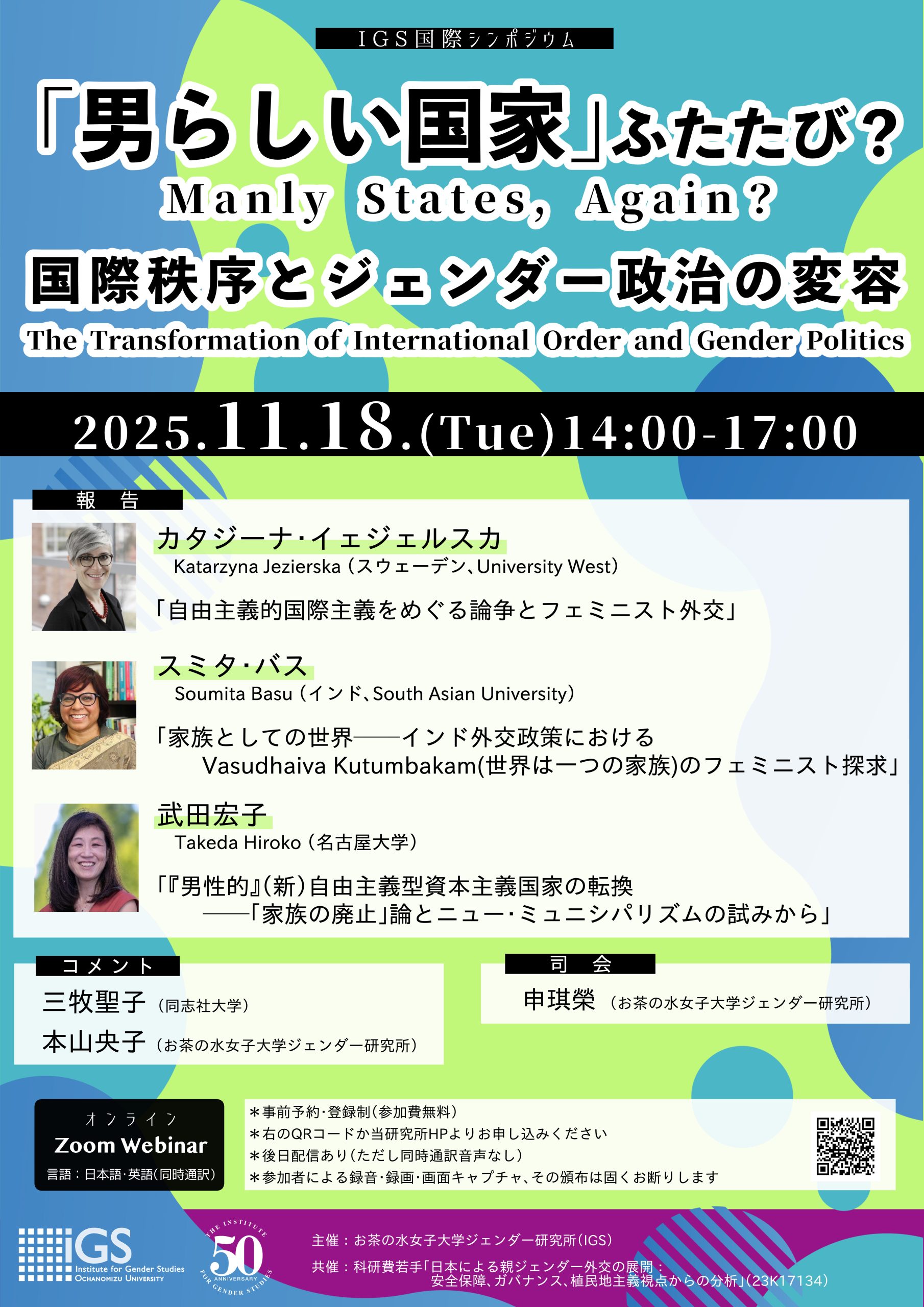
 2025.11.18 IGS International Symposium
“Manly States, Again? The Transformation of International Order and Gender Politics”
The IGS International Symposium, “Manly States, Again? The Transformation of International Order and Gender Politics,” held on November 18, 2025, featured three individual presentations, followed by discussion led by two designated commentators.
The first speaker, Katarzyna Jezierska, delivered a presentation entitled, “Debate Surrounding Liberal Internationalism and Feminist Foreign Policy.” She pointed out that although Western countries are not the sole originators or drivers of the liberal international order, this narrative has nevertheless become dominant. In the process, the contributions of non-Western countries, particularly those in Latin America and Asia, have often been marginalized or overlooked. Since Sweden explicitly announced the adoption of the world’s first Feminist Foreign Policy (FFP) in 2014, fourteen countries have followed suit. However, in recent years, some Western European states have begun to retreat from FFP under pressure from domestic gender-conservative parties. At the same time, progressive feminist actors have raised concerns about whether FFP is “truly” feminist and have criticized it as potentially reproducing a colonial project framed as “saving women” in formerly colonized regions.
Taking such backlash and critiques seriously, Jezierska emphasized the need to construct a new narrative for FFP. In doing so, she argued that it is essential to reinterpret FFP in ways that render visible the contributions of countries in the “South” and the “East,” particularly Latin America, which have articulated feminist thinking and policy solutions in foreign affairs. She concluded by suggesting that adopting an approach of “critical friends” offers a productive pathway for engaging with both the liberal international order and FFP.
The second speaker, Soumita Basu, delivered a presentation titled “The World as Family: A Feminist Exploration of Vasudhaiva Kutumbakam (‘The World Is One Family’) in Indian Foreign Policy.” Focusing on vasudhaiva kutumbakam, an idea recently promoted in Indian diplomacy, she examined the 2023 G20 Summit, hosted by India, as a case study. The concept, derived from ancient Hindu philosophy, means “the world is one family.” Under this framework, the G20 adopted the official theme “One Earth, One Family, One Future.” The “family” was positioned as the basis for building global support systems, with “mothers” framed as a driving force and particular emphasis placed on women-led development. However, this concept has prompted critical questions: Who serves as the head of this “family”? How is power distributed? How are conflicts resolved?
Drawing on feminist IR scholar Fiona Robinson, Basu noted that the sovereign state model, which prioritizes autonomy over dependency, and foreign policy approaches centered on national interest run counter to the spirit of relationality. While acknowledging this, she argued that for countries in the Global South that have resisted imperialism, state institutions and foreign policy can function as tools for transforming asymmetrical international relations, and that the underlying principles of such efforts resonate with FFP.
Referring to a dispute between China and India over wording in official G20 documents, Basu suggested that the limits of vasudhaiva kutumbakam become apparent precisely when national interests take precedence. She concluded that transformative gender politics requires a fundamental critique and reconstruction of the existing international order, and that feminist critiques of the family as an institution may be a useful analytical resource.
The third speaker, Hiroko Takeda, presented a paper entitled “The Transformation of the ‘Masculine’ (Neo)Liberal Capitalist State: From Debates on the ‘Abolition of the Family’ to Experiments in New Municipalism.” Drawing on the work of political theorist Melinda Cooper, Takeda first reviewed how, within the U.S. neoliberal political economy, the family has been positioned as a vehicle for the pursuit of happiness, a provider of services to its members, and a driver of financialized capitalism. She then turned to Japan’s “family planning” policies introduced in the 1950s, showing how they were linked to an idealized image of the “happy family” and how the family came to be positioned as a provider of social welfare services.
In a context where family formation itself has become increasingly difficult in Japan, Takeda introduced “Family Abolitionism” and “New Municipalism” as frameworks for transforming the relationship in which the family underpins neoliberal economic and governance systems. New Municipalism refers to efforts by municipalities to build forms of autonomy that extend beyond the nation-state, including through global networks such as Fearless Cities, in which municipalities share strategies and expertise. Takeda concluded that such practices can cultivate our political imagination, and that feminist political economy offers important inspiration for this task.
The first commentator, Hisako Motoyama, observed that the three presentations shared key themes, including postcolonialism, relationality, family, and the state, while approaching the relationship between the liberal international order and feminism from different angles. In response to Jezierska, she noted that a feminist relational approach challenges the very assumption of the autonomous sovereign state and calls for a radical reimagining of relations among states, among people, and even between humans and non-human actors. She asked for concrete examples of FFP practices capable of overcoming the limitations of the liberal international order. Turning to Basu’s presentation, she contrasted Robinson’s more fundamental critique of the state with Basu’s state-centered approach, which sees potential for transforming unequal international relations, and asked Basu to clarify how her understanding of feminist relationality differs from Robinson’s. Regarding Takeda’s presentation, she raised questions about what implications “family abolition” might hold for sovereign states, and how international relations grounded in interactions among sovereign states might be reimagined.
The second commentator, Seiko Mimaki, pointed out that FFP can exhibit affinities with Eurocentrism and militarism (i.e. The justification of military intervention in the war in Afghanistan). Mimaki highly praised the ways in which Jezierska and Basu made clear the contributions of non-Western women that have often been forgotten in the history of FFP, and their efforts to explore new possibilities for FFP. She further asked how growing critiques of “white feminism” in relation to Gaza should be understood and addressed, and how to interpret differences in stance and the lack of solidarity among non-Western countries regarding Israeli military actions. Regarding Takeda’s presentation, she questioned the external implications of hegemonic masculinity in contemporary Japan and asked what kind of political transformation would be necessary for Japan to overcome Western-centric FFP and build solidarity with non-Western countries.
Following the speakers’ replies, questions spanning many topics were raised from the floor. These included questions regarding feminist divisions over Gaza; the contradiction between adopting FFP and continuing military trade; the role of hegemonic masculinity in shaping young men’s support for the Takaichi administration; Basu’s assessment of “othermothering” as a practice associated with family abolitionism; and feminist evaluations of Japan’s approach to the Women, Peace and Security (WPS) agenda. Lively discussion continued until the event concluded.
Sera Ono (Researcher, Faculty of Core Research, Ochanomizu University)
(Translation by Emi Yasuda)
|
《Event Details》 【Date/Time】Tuesday, November 18, 2025, 14:00–17:00 (JST) |